Can't find what you are looking for ?
Google


Showing posts with label English. Show all posts

Tuesday, September 29, 2009

Movie: My Name is Nobody (1973) - A comic spaghetti western

Spaghetti westerns had ceased to be serious stuff by the early 1970's, and people had started making comic westerns such as the Trinity series. Terence Hill was the new master of such movies, and when you combine him with the serious western star Henry Fonda, with some direction (not overall) by Sergei Leone, and with some great soundtrack by Ennio Morricone, you get a great movie. And this is what 'My Name is Nobody' was all about. Read more at this link:


The movie was mostly directed by Tonino Valerii, with Sergei Leone directing a few scenes, but since there was the involvement of Sergei, the movie came to be known as a Sergei Leone movie (something that Torino was not happy about). The music by Ennio Morricone was superb as usual.


However, 'My Name Is Nobody' is the story of a famous (and old) gunslinger Jack Beauregard (Henry Fonda); since he is famous, he is constantly hunted by the younger punks who want to challenge him, and if they win, they will be the next famous ones. Jack, after a lifetime of fighting, now just wants to hang up his boots, and is in Europe, hoping for some peace and quiet.


My name is Nobody (1973) (partial direction by Sergei Leone and starring Henry Fonda, Terrence Hill, and Jean Martin)

English classic - Vanity Fair (1847-48)

A classic book by William Makepeace Thackeray, a satire about society in Victorian times, around the time of Napoleon, and contrasts the tale of 2 women, one of whom will do anything to get what she wants, and the other one, who is honest, believing, and trusts people even when they are not to be trusted.
A review of this book (link to article):

The title of the book, Vanity Fear, is taken from an earlier work, John Bunyan's allegorical story The Pilgrim's Progress, published long before in 1678, and supposed to represent a place called Vanity, where there is a ongoing fair that is meant to represent man's attachment to worldly things, and supposed to represent the sin of man. The book was seen as a bitter satire of society, as showcased in the quest of one of the anti-hero (or anti-heroine, to be more accurate), who is cunning, and uses all her qualities to work her way up in life.

Thursday, September 24, 2009

English Moviel: A Fistful of Dollars (1964): The original spaghetti western

In the 60's, and the early 70's, Spaghetti Westerns, shot with young or ageing US leads along with Spanish / Italian stars, and using an Italian / Spanish cast caught on, and continued till the early 70's, when people started getting tired of this line of films. Two of the people who were most closely associated with these types of movies were the director, Sergei Leone, and the young upcoming star, Clint Eastwood. Clint Eastwood came to be famous for a trilogy of movies called the "The Dollars Trilogy" or "The Man With No Name Trilogy" - primarily because Clint was not given a screen name in these movies, and this was in effect used as a promotion point for these movies. A Fistful of Dollars was the movie that started this trend, and was the first movie in the trilogy, with the others being For a Few Dollars More (1965) and The Good, the Bad and the Ugly (1966). Most of these movies were shot in Spain, in regions that resembled the dry, wasteland like region of the American Southwest. Another great highlight of the movie was the music by Ennio Morricone.


The Spaghetti Western culture had a touch of irony to it, since the original role was offered to Henry Fonda and Charles Bronson, but both of them refused, and a few others, after which Clint Eastwood was signed on. With the success of the genre, both of them starred in a later movie of his, Once Upon a Time in the West (1968).
A Fistful of Dollars is the story of a man arriving at a small town on the Mexican Border called San Miguel, and how he gets involved in the huge rivalry in the town between 2 families who want to establish their dominance in the town. These 2 families are;
- The Rojo brothers, Don Miguel, Esteban, and Ramón.
- The other family is that of the sheriff John Baxter (Wolfgang Lukschy)
The Man with No Name arrives in the town, and sees a chance to make some money ('a fistful of dollars') in this rivalry between them, but gets involved in a different way, by rescuing the captive of Ramon, Ramon's mistress (Marisol).
The Rojos catch Clint Eastwood and torture him for this effrontery, but he manages to get free with the help of the coffin maker. In their search for him, the Rojos finally get up on the Baxters by burning down their home and killing them all. Now that they are the one strong family in the town, the stranger returns to a final fight, and finally kills them all, and then moves out before the authorities make their presence felt.

A fistful of Dollars (1964), released in the United States in 1967, and starring Clint Eastwood, directed by Sergei Leone

Tuesday, September 22, 2009

Book: Forward the Foundation by Isaac Asimov (1993)

Isaac Asimov wrote a huge amount of science fiction over the years, and is known for many of his books such as the Empire Series, and most famously for the Foundation Series. The 3 main Foundation books were the 'Foundation', 'Foundation and Empire', and 'Second Foundation'. It was later, in order to try and fill more details, that Asimov wrote more books for the Foundation, that include books that were both prequels and sequels. The last such book that he wrote was called 'Forward the Foundation', and was released in 1993, a year after Asimov died. Forward the Foundation was a sequel to 'Prelude to Foundation', carrying on with the story of Seldon's search for how to develop the story of psycho-history.


Read more at the following location (link)

Thursday, September 17, 2009

Movie: Once Upon a Time in the West (1968)

Sergio Leone was the king of the Spaghetti Western brand of movies, with Clint Eastwood being the star in many of those. Henry Fonda was another famous star of the era, acting as the hero in many a film. However, in this film, Henry Fonda plays one of the villains, with Charles Bronson playing the lead role in the movie. The movie 'Once Upon a time in the West' was released in 1968 in Europe and was a fairly big success, running for a long time in many cities. However, this was not be in the United States, where it was released in 1969, and was a flop. Like some other movies that were well made but did not do well commercially, Once Upon a Time in the West is now regarded as a very well made movie, and among the greatest westerns. The movie starred, besides Henry Fonda and Charles Bronson, Jason Robards as the bandit Cheyenne and Claudia Cardinale as Jill (a lady who arrives at her new house to find herself a widow and her entire family killed).


The movie is about the fight for getting control of the rights for providing water (and a supply depot) to the railroad that will run past the town of Flagstone, with the farm being in the best position to supply water and other supplies to the railroad. The movie starts with a scene of a remote town in Arizona, where a train arrives, on which a stranger with a harmonica in his mouth (Bronson) gets down, hoping to find Frank (Fonda) there, but instead meets 3 men with whom he has a showdown and, he is the only survivor. At the same on a remote farm, where the McBains are waiting for a new wife Jill (Claudia Cardinale) for Brett McBain, a gang led by Frank come and kill all of them.
Soon after, Jill arrives at the station and starts to the farm. On the way, she meets the harmonica player and also the bandit Cheyenne (Jason Robards). When confronted by Branson about the shoot-out, Cheyenne denies that the men killed were his men. And then Jill arrives at the farm to find that her new family is all dead, but she tells the assembled crowd that she had already married McBain a month back. On the basis of some false evidence, the crowd believe that the murders were done by Cheyenne, and form a posse to hunt him down.
And then you start to discover as to why these killing happened .. this is all related to the railroad that the tycoon Morton (Gabriele Ferzetti) was building that would go upto the Pacific, and Frank works for him. The story is interesting, with the collision between these different men, all of them with their own interests, and how they all come together in the end. The movie is interesting, and with some great scenes. A must watch.

Once Upon a Time in the West (1968) starring Henry Fonda, Charles Bronson, and directed by Sergio Leone

Thursday, September 10, 2009

Classic Movie: The Good, The Bad, and The Ugly (1966) - A great Spaghetti Western

This is a movie that will certainly not win any major awards, and was a major constituent of what were called the 'spaghetti westerns'. It was a movie directed by Sergio Leone, and starred Clint Eastwood (and Sergio Leone was the master of the art, having made a large number of such movies). What were Spaghetti Westerns ? - These were films that started coming out in the 60's, and continued till they started becoming the butt of jokes in the 70's, after which these died out. The other specialty of these movies is that they were primarily directed and produced by Italians, with a mix of young and upcoming Hollywood actors, and many other members of the cast being a mix of Italian and Spanish actors. A large number of these movies were made with a desert, wild countryside, to resemble the American Southwest (although the shooting of many of them was done in a region of Spain that was similar).


The movie has 3 characters representing each of the 3 terms:
- The Good: Clint Eastwood as Blondie. Also famously known as 'The Man with No Name'. A bounty hunter who is the best of the 3, but who can shoot first if his morals allow it as a case of self-defense. He can also swindle as part of his bounty hunter job in order to make money. Blondie knows the name of the grave stone where confederate money is hidden, but his partner knows the name of the cemetery, and hence they need to work together.
- The Bad. Lee Van Cleef as Angel Eyes. A sociopath, a mercenary also known as 'Angel Eyes', who can kill or shoot anybody in his path. He, as a Sergeant interrogates Tuco, and discovers the name of the cemetery where the gold is hidden, but is unable to get the exact grave stone.
- The Ugly. Eli Wallach as Tuco. More of a lout, wanted by the authorities (and he uses this fact as part of his partnership with Blondie to make money). He finds the name of the cemetery (Sad Hill Cemetery) where the gold is hidden, but Blondie gets to know the name of the grave stone. He is partnering with Blondie, but at some point, they are all in for themselves.

The movie is mainly about these 3, and their quest for finding hidden confederate gold. Blondie and Tuco are on/off partners, but are forced to become good partners when one of them gets to know the name of the cemetery where the gold is hidden, and the other gets to know the name of the grave stone. And then there is the third one, Angel Eyes, who also gets to know about the gold, and will not let anything stand in his way, including making a temporary partnership with Blondie to discover the gold. The movie is about their quest, mixed with scenes of treachery, bitter battles between the Union and Confederate forces (the movie is set in the Civil War timeframe). In the end, the three are standing in the cemetery, guns drawn, in a Mexican stand-off with each other. Who will win ?

The Good, The Bad, and The Ugly, a spaghetti western starring Clint Eastwood and Lee Van Cleef (released in 1966)

Wednesday, September 9, 2009

Book: Emma by Jane Austen (1815)

Jane Austen wrote many books, with her most famous books being Sense and Sensibility (1811), Pride and Prejudice (1813), and Mansfield Park (1814). Emma came after these 3, and has taken its time to become famous. Further, since Jane Austen chose to write her books anonymously, her books started becoming famous long after her death, with a biography by her nephew, written more than 50 years after her death, that awoke more interest in her. It was only in the early half of the 20th century that she started being acknowledged as a classical writer, and now her works are very famous. Jane Austen remained unmarried, dying at the relatively young age of 42, from an affliction that was not particularly known at that time, but which is now suspected to be Addison's disease or Hodgkin's lymphoma.
Like her other works, Emma was also a critique of the society of that time, where a woman's standing was supposed to be based on marriage, and it would be this marriage that would decide her economic and social security; even though her works have a strong touch of comedy to them.


Emma is essentially a novel that describes the life of a 21 year old girl called 'Emma Woodhouse'. She is not worried about finances, being comfortably off; however, she starts to believe that she is good at match-making and guiding who should marry whom, something that causes a lot of temporary changes in the lives of people around her; in the end, however, everybody settles down happily, including her. There are a number of characters in the novel, and you will need to read carefully to ensure that you don't miss any of the turns and twists of the story.
Emma lives with her father, and has just returned from the marriage of her former governess Miss Taylor, and since she had introduced Miss Taylor to her husband, Emma feels that she has a gift for match-making. One of her closest friends is a person called George Knightley, who is from the neighboring estate, as well as the brother of her sister Isabelle's husband. He is perhaps the only one who is able to criticize actions taken by Emma when he feels that she is wrong. Who is the first person on whom Emma tries out this ability of hers ? It is her new friend, the 17 year old Harriet Smith, who is very sweet, but not very bright.
And here starts the main story. Harriet has got a proposal from a rich farmer called Mr. Martin, but Emma has decided that Mr. Martin is not good enough for Harriet, she would be more suited to the local vicar, Mr. Elton. And then, the unthinkable as per Emma happens - Mr. Elton realizes that Emma is a better catch, and proposes to Emma. Her friends had realized that this would happen, but not Emma. When Emma tries to direct Mr. Elton to Harriet, Mr. Elton makes it plain that he considers Harriet below him, and leaves the place for a while.
The story introduces more characters, and spins around the lives and marriages of these folks, and is fairly interesting.

Emma (1815), a book on England in the 19th century by Jane Austen

Monday, August 31, 2009

English Movie - Fugitive: A tight story of being one step ahead of the law

A fast paced action movie, with a fair amount of drama, a wrong court decision, and the need to get revenge (and clear his name) were some of the parts that made The Fugitive a very famous and commercially successful movie. The movie was nominated for a clutch of Oscars, and also earned more than $500 million worldwide. It helped that it starred 2 famous actors in the person of Harrison Ford (very famous for Star Wars and Indiana Jones), and Tommy Lee Jones. The movie also got good reviews from critics, making it really successful (it is not always seen for a movie to be both commercially successful and earn praise from critics).
The movie was released in 1993, and was based on a television series that aired on ABC between 1963 and 1967. The series ran for 4 years (interestingly, the first 3 seasons were in black and white, and the fourth season was in color). The movie has the same premise, where a doctor is charged for the murder of his wife, and escapes in order to prove his innocence.


The movie has principally 2 characters - Harrison Ford as Dr. Richard Kimble, and Tommy Lee Jones as Deputy United States Marshal Samuel Gerard. Dr. Kimble has been charged for the murder of his wife, based on the fact that his wife made a call to 911 which apparently led to Dr. Kimble being blamed for the murder. In addition, there was no evidence to back the claim of Dr. Kimble that a man with an artificial hand was responsible for the murder (there were no signs of somebody breaking into the house, there were no other fingerprints on the gun). Dr. Kimble was charged for murder, and convicted by a jury, sentenced to die.
However, on the way to prison in a bus (along with other convicts), there is a disturbance inside the bus that causes the bus to fall onto the path of an oncoming train. In the disturbance. Dr. Kimble manages to run away and is now being pursued by the United States Marshal service, led by officer Samuel Gerard. Kimble manages to change out of his prison uniform, shave, and alter his appearance, but Gerard is soon on the chase, and manages to corner him inside a storm drain inside a dam. The only option for Kimble to survive is by jumping into the flow of water falling from the dam, and he does so in a fairly spectacular shot.
Now, Kimble is on a mission to find people who have received a prosthetic arm, while striving to be hidden from the police who is chasing him. In the middle of this, while hidden in a hospital, he even saves a boy by altering the diagnosis and sending him to emergency surgery. Kimble even heads to the jail to try to find the one-armed man, but is not able to find him. He eventually gets into the home of a former police office called Frederick Sykes (Katsulas). Sykes was there in Kimble's list since he had received a prosthetic arm. It is in Sykes's home that Kimble finds evidence of what could have caused the attacks at Kimble's home, as well as the involvement of somebody close to Kimble. Can Kimble save himself from the police, and expose the involvement of others ?

The Fugitive was nominated for 7 Oscars:
Won: Best Supporting Actor - Tommy Lee Jones
Best Picture (lost to Schindler's List)
Best Cinematography (lost to Schindler's List)
Best Sound Effects Editing (lost to Jurassic Park)
Best Film Editing (lost to Schindler's List)
Best Original Music Score (lost to Schindler's List)
Best Sound (lost to Jurassic Park)

The Fugitive (1993) Oscar award winning movie starring Harrison Ford and Tommy Lee Jones

Saturday, August 29, 2009

Book: Wuthering Heights by Emily Bronte (1847)

Wuthering Heights is a classic of the Victorian Era, written by Emily Bronte (and released in 1847). This was the only work of fiction by Emily, although her more famous sister, Charlotte Bronte wrote many more works of fiction (including the very famous Jane Eyre). Wuthering Heights was released not under the name of Emily, but under a pseudonym of Ellis Bell (because there was a prejudice in society that time directed at female writers, and Charlotte was also writing under a different name). Emily died the next year, in 1848, and a second edition was released later in 1850, edited by Charlotte. Emily had a relatively short life, and lived only from 1818 to 1848, dying after contracting tuberculosis.
Wuthering Heights was not a great hit when it came out, given that depiction of relationships and am over-riding sense of revenge and cruelty ran through the book. However, over the years, the book has come to become much more respected, and is now considered a literary classic, with many considering it superior to Jane Eyre.
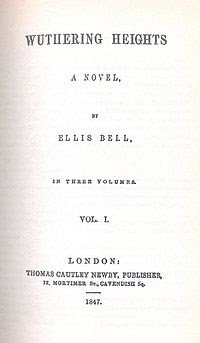
Wuthering Heights, a classic novel by Emily Bronte, published in 1847

The narrative is essentially about how emotions can guide the behavior of a person, with feelings of rejection and hatred making a person spend his entire life in revenge, tormenting people, seeking to get revenge. It is also a tale of unrequited love, with the passionate love between Heathcliff and Catherine Earnshaw (a love that had a tragic ending) causing Heathcliff to spend his entire life in how to get revenge. The narrative jumps a bit between the present and past, and is presented by 2 characters - Mr. Lockwood and Ellen "Nelly" Dean, with the main setting of the novel starting in the year 1801.
The novel starts with Heathcliff, a young homeless orphan is brought to Wuthering Heights by Mr. Earnshaw, and raised like another son. Heathcliff makes very close friends with the daughter, Catherine, although her brother, Hindley, does not like Heathcliff and mistreats him. After the death of Earnshaw, Hindley takes over as owner of Wuthering Heights, and badly treats Heathcliff. In the meanwhile, Catherine becomes close to a neighbor, Edgar Linton, something that Heathcliff does not like. He dislikes Linton.
Hindley's wife dies, and Hindley is in despair, taking on heavy drinking; around this time, Catherine decides to marry Linton, something that will profoundly affect Heathcliff. When Heathcliff leaves after feeling that Catherine considers it degrading to marry him, Catherine is struck by a fever, and Edgar Linton takes care of her, and in a couple of years, they get married. And then Heathcliff returns, having suddenly turned very wealthy, and intent on taking revenge on all those who prevented him from being with his love. He lends to Hindley, and then takes over Wuthering Heights after Hindley dies; further, he elopes with Linton's sister, Isabella, all for revenge. However, soon after, Catherine dies, with her and Heathcliff being reconciled just before her death.
Heathcliff becomes more angry, and hate prone, carrying on his hate onto the various children, Hindley's son Hareton, his own son Linton, and Catherine's and Edgar's daughter, also called Catherine. What will happen next, since eventually Isabella and Edgar Linton also die, leaving the various children at Heathcliff's mercy.

Saturday, August 22, 2009

Maverick (1994) - a Western comedy starring Mel Gibson

The movie is based on a Television Series that ran between 1957 and 1962, starring James Garner in the lead role (and the 1994 film was not the first movie made on this TV series, just the latest). What does Maverick actually mean ? Maverick was termed after Samuel A. Maverick (1803–70), a Texas pioneer who left his calves unbranded (as opposed to most people who put a brand on their livestock). Maverick is also a term used for somebody who takes a stand very different from colleagues, and in the case of the movie, maverick is meant to depict a person who behaves most unpredictably.
The movie was meant to be a good combination of humour (sometimes dark) along with a fast moving plot with surprises at every corner, and was a decent box office hit. It was never meant to be pitching for the Oscars, and hence must have been surprised when it got nominated for Oscar for Best Costume Design.
The movie is set in the American Wild West, with a certain disregard for the law, and where a man makes his own fortune with a gun and his own instincts. In this case, Bret Maverick (Mel Gibson) is on his way to a major five-card poker competition. Since he is a gambler, winning such a competition is a way to prove that he is the best. He however needs to collect money owed to him, and he needs this amount since there is a $25,000 entry fee for the tournament, and he is $3,000 short.


The movie is not only about the poker competition, but also about the journey that Maverick takes to reach there. He meets 3 co-passengers called Angel (Alfred Molina), a young con-artist calling herself Mrs Annabelle Bransford (Jodie Foster), and Marshal Zane Cooper, a legendary lawman of the west (this role is essayed by James Garner, who played Bret Maverick (played by Mel Gibson in the movie) in the original TV series). Maverick is going to have a running battle with Angel during the movie, as they are also rival gamblers.
They go through a series of adventures, including one in which the driver of the stage-coach dies when the coach is moving at full speed and the coach needs to be controlled, more adventures with Indians, manipulated by Maverick. In between Angel waylays Maverick, attempting to hang him from a tree. However, Maverick eventually escapes and manages to join the game. Eventually, after early rounds, the 4 finalists of the game are Bransford, Angel, Maverick, and Commodore Duvall (James Coburn), who is the organizer of the tournament, and the owner of the boat on which the tournament is being held. Cooper is responsible for security of the tournament.
Eventually, Maverick wins, and in the resultant shoot-out, Angel is killed by Cooper and Maverick. However, the movie has its twists in the end, and Cooper runs away with the money rather than give it to Maverick, and it further turns out that the Commodore was also in league with Cooper. What happens next ? Does Maverick get the money back ? What about Bransford ?

Maverick (released in 1994), starring Mel Gibson, Jodie Foster, and James Garner

Tuesday, August 18, 2009

Book: Pale Blue Dot by Carl Sagan (1994)

The complete name of the book is called "Pale Blue Dot: A Vision of the Human Future in Space" and it was another non-fiction book released by Carl Sagan (the famous astronomer and scientist) who wrote a series of books on science and space, and is most famous for his works, Cosmos and Contact. The name of the book is based on a photograph taken by the space explorer spacecraft, Voyager 1. Carl Sagan had pushed for the spacecraft to take a photograph when it was at a huge distance from the earth, a distance of 3.7 billion miles. In this photograph, the Earth seems nothing more than a Pale Blue Dot in the midst of empty space, and this is all that mankind has got.
Carl Sagan also described this photo in a speech he was giving, with these starting words: "Look again at that dot. That's here. That's home. That's us. On it everyone you love, everyone you know, everyone you ever heard of, every human being who ever was, lived out their lives. The aggregate of our joy and suffering, thousands of confident religions, ideologies, and economic doctrines, every hunter and forager, every hero and coward, every creator and destroyer of civilization, every king and peasant, every young couple in love, every mother and father, hopeful child, inventor and explorer, every teacher of morals, every corrupt politician, every "superstar," every "supreme leader," every saint and sinner in the history of our species lived there – on a mote of dust suspended in a sunbeam."

Pale Blue Dot: A Vision of the Human Future in Space, by Carl Sagan (1994)

The book takes a look at previous theories of the geocentric Earth-centered universe, and how that was the idea that could not be challenged, with torture awaiting those who dissented. Slowly, that idea was overturned and we started learning about reality, about our true size in the enormity of the universe, starting with the scale of the solar system, and then continuing with the idea of how to explore the planets in the solar system. Carl Sagan also talks in detail about the Voyager program. The book also has some great photos of the Solar System, courtesy of NASA.

Chapters

Wanderers: An Introduction
You Are Here
Aberrations of Light
The Great Demotions
A Universe Not Made for Us
Is There Intelligent Life on Earth?
The Triumph of Voyager
Among the Moons of Saturn
The First New Planet
An American Ship at the Frontiers of the Solar System
Sacred Black
Evening and Morning Star
The Ground Melts
The Gift of Apollo
Exploring Other Worlds and Protecting This One
The Gates of the Wonder World Open
Scaling Heaven
Routine Interplanetary Violence
The Marsh of Camarina
Remaking the Planets
Darkness
To the Sky!
Tiptoeing Through the Milky Way

Sunday, August 2, 2009

Movie: 300 (Released in 2007) - Historical battle and valour

The ancient world was replete with fights and wars. Armies travelled long distances to fight, and warfare was often with massive casualties. One of the most famous kings of the ancient times was Xerxes The Great (Xerxes 1 of Persia), and he was involved with one of the most famous battles of historic times. This was the Battle of Thermopylae (wikipedia), where a much smaller contingent of Greek troops led by the King Leonidas I of Sparta fought till the end to hold off a much larger contingent (in the millions) of Persian troops led by King Xerxes. This was a battle that is part of modern strategy because of the use of terrain planning to level the odds of superior armed forces. King Leonidas was also fighting a rear-guard battle with his Spartan council to get them to support him over this battle, and he wanted to shame them with his valiant sacrifice to take action. In the end, he was betrayed by a traitor (Ephialtes) from within the Greek citizenry who revealed a small path that allowed the Persians to outflank the small Greek army.

300 Historic Movie with battle between Persia and Greek, released in 2007

The movie is a copy of a graphic comic-book style novel by Frank Miller (with the novel having the same name), and is not a re-telling of the actual battle. It is a heavily dramatized telling of the story, and hence also became controversial. In Iran, the movie was heavily criticized because the movie did not portray the Persian army and its King in a very positive light. The movie was directed by Zack Snyder. The movie was also shot in a novel way, with the characters acting against the background of bluescreens in a Studio (shot in a digital backlot technique). This was seen as very innovative and got a lot of publicity. The score of the movie was also controversial because after release, it started becoming clear that the score seemed to be heavily inspired from other movies, and was eventually acknowledged by Warner Bros. Pictures in an official statement.
The movie is about the conflict between King Leonidas of Sparta and the Persian Emperor Xerxes. Xerxes wants the Greeks to acknowledge their submission to him, something the proud Spartan king refuses to accept. Leonidas now anticipates war, and wants the support of the Council of Sparta and the priesthood (Ephor), but the Ephors do not support him (they have been bought over by the Persians). Without this support, Leonidas sets out with a small force to fight at a superior terrain where we can fight and hold off the numerically many times superior Persians. And hence the battle starts at Thermopylae. where Leonidas refuses riches by Xerxes and promises to make him bleed. The Spartans used their tight formations to defeat the many thrusts by the Persians, but look set for defeat when they are betrayed and a secret path is shown to the Persians.
In Sparta, the Queen is trying to rally support, and eventually manages to get the Council united in battle against the Persians. Eventually, the Spartans are beaten by the sheer force of the Persians, but by this time, the Greeks send in a force that has a much higher number of warriors. With memories of losses against 300 Spartans, the Persian army is low on morale, and eventually lose the final battle, the Battle of Plataea (Wikipedia).

Movie: The Day After Tomorrow (2004): The ultimate disaster movie

This was a movie released in 2004, at a time when the Bush Administration was steadfast in claiming that there was no global warming (or rather, that the science proving it was not confirmed), and there were sections of the scientific community and in society that were unhappy over this attitude of the administration. The fact that the admnistration was much closer to the business community which would be affected if measures needed to be taken to fight global warming compounded the response of this section of society. So keep in mind this fact while watching the movie, given that it touts that global warming can cause huge damages to our community, and that the political leadership is too blinkered to be able to take effective measures.
Global warming is a fact, and nations all over the world are talking (mostly talking) about how to address this problem, and are debating who needs to take what steps. It is a game for rich nations to worry about the effect on the economy, a huge debate between rich and poor nations about responsibility and steps to be taken, but it is coming and will keep on affecting us. This movie took the scare due to global warming to a much higher level, and keep in mind that there are almost no scientists who share the vision of a much accelerated change that is shown in the movie.

The Day After Tomorrow (2004) - apocalyptic science-fiction, Vision of Disaster

The movie was hugely successful (earning more than 650 million dollars), and brings to its viewers a vision of the full power of Mother Nature. The movie however did not earn much critical acclaim for its scientific background, and was criticized by a number of scientists working in the Global warming area; the feeling being that the movie, by showcasing a sudden onset of disaster and moving away from the decades based impact of global warming and makes the whole science seem freakish and unconvincing. One area where the movie won a lot of praise was in the area of its special effects, especially the disaster scenes.
The movie starts with scientific research on the ice shelf, Larsen Ice Shelf. Jack Hall (Dennis Quaid) is drilling for ice cores in the Antartic for NOAA. Suddenly, the ice shelf separates, and Jack almost dies. Jack travels to a conference on Global Warming in New Delhi where diplomats from all over the world have gathered in order to present his theory, but of course, politicians (including the Vice-President of the United States (resembling Dick Cheney)) refuse to believe him. However, the weather has other ideas. Another scientist (Professor Terry Rapson (Ian Holm) of the Hedland Climate Research Centre in Scotland) looks at Jack's theory and does not dismiss it. When he returns to Scotland, data from 2 water buoys in the North Atlantic show sudden drops in the temperature of the water. Unknown to humanity, the deep chill caused by global warming has begun.
Professor Rapson and Jack talk about Jack's theory, but Jack's theory was over a long period of time, not supposed to happen suddenly. Jack starts to build a computer model based on his theory, and on data, and the model is horrific in terms of what will happen. And the weather systems all over go haywire. Tokyo is hurt by a huge hailstorm, Los Angeles is decimated by tornadoes, planes get caught in the weather turbulence. Eventually, air traffic is stopped. British RAF helicopters are suddenly frozen as they pass through the eye of a superstorm. The human element to the movie is the father-son relationship between Jack and his son Sam (Jake Gyllenhaal) who have travelled to New York City for a competition, when the weather system turns haywire. Jack heads to New York to get them back to safety.
The predictions of storms, of an ice wave are so strong that it is recommended to evacuate the Northern Unites Stated and move to the South and to Mexico. In the meantime, Sam along with friends have taken refuge in the New York Public Library. Eventually, Jack manages to make it to the Library and get help for everybody over there, after the superstorm has passed.

Sunday, July 26, 2009

English Movie - The Last Samurai (2003) - starring Tom Cruise~

The Last Samurai is set during tumultuous times in both the United States and Japan. The movie is set during the 1870's, a decade after the American Civil War, a time when the United States fought an intense internal war between the forces of the Union and the Confederates. Similarly, there were dramatic changes going on in Japanese society at that time. The 'samurai' (warrior class) that were a major elements in Japanese society were losing their position and influence, and a proper military was starting to form. This was the time of the Meiji Restoration of 1867-1868 (wikipedia).
The story of the movie is about an old warrior, named Captain Nathan Algren (Tom Cruise), who is a veteran of the Indian wars (where the United States Army fought the Native Indian tribes), and who is traumatized by his role in a massacre of Native Indians. He is wandering around pretty aimlessly, making a living by recounting his adventures in gun shows, something that earns him a living, but does nothing to enliven his life.

Movie poster - The Last Samurai (2003) - starring Tom Cruise

However, he is a perpetual drunk, and is finally fired from his job; now he has pretty much no options other than to accept an offer to train the Imperial Japanese army (part of the growing western influences in Japan post the Meiji Restoration). This offer is made to him by his former commanding officer, Lieutenant Colonel Bagley (Tony Goldwyn). Algren pretty much blames Bagley for his transgressions during the war, and has no love lost for him. This offer from Bagley is made on behalf of a Japanese businessman who has stakes in the restoration, called Mr. Omura (Masato Harada).
Algren goes about this task, training peasants and farmers in how to handle rifles as part of this training. However, in their first conflict, they come into battle with a group of rebel samurai warriors, led by Katsumoto (Ken Watanabe); the army is unequal to the battle and gets defeated by the samurai. One of Algren's colleagues is killed in this attack, and Algren himself fights valiantly, defeating and killing the brother-in-law of the samurai leader. In this fight, he uses a spear with a flag of a white tiger, and Katsumoto believes that to be an omen, and spares Algren's life and takes him prisoner.
Algren is now prisoner at a remote village, living in the house of Hirotaro, whom he had killed. In this village, Algren finally starts to become more at peace him himself, and also starts to really learn the art of wielding the samurai sword as well as learn the Japanese language. In a fight with ninja assassins who had attacked the village, Algren fights along with the samurai, and manages to give a good account of himself even though the samurai take several losses.
With spring, Algren is now back in Tokyo, but now refuses to support Omura in his battle with the samurai, and at the same time, Katsumoto is arrested even after offering advice to the emperor. Algren manages to help Katsumoto regain his freedom, even though in this effort, Katsumoto's son, Nobutada (Shin Koyamada) is killed. After regaining his freedom, Katsumoto learns that a better equipped army unit is going to attack a much smaller samurai force, and it is there that Algren recalls the Battle of Thermopylae, where a much smaller force used better technology and the advantage of terrain to defeat a much larger army.
This comes true as the samurai are able to lead the larger army into a trap, however, soon the samurai realize that the army will get backup units, and another such battle will mean defeat. They resolve to make an attack of their own. However, they face canon fire, something that proves murderous, and then a second unit of infantry. In a battle, Algren kills Bagley when Bagley attacks Katsumoto; but then the second line of Gatling guns hit the samurai as they advance. The Japanese army, then ceases fire in respect of the samurai. Katsumoto ends his life.
In the end, as the emperor prepares to sign a deal with American ambassadors that would make the US as the exclusive dealers for firearms, Algren presents Katsumoto's sword to the emperor; the emperor understands the message and refuses to sign the deal, and also reduces Omura's powers and influence when he objects. Algren returns for the peace he finally found to the small Japanese village.

Track listing:
"A Way of Life"– 8:03
"Spectres in the Fog"– 4:07
"Taken"– 3:36
"A Hard Teacher"– 5:44
"To Know My Enemy"– 4:48
"Idyll's End"– 6:40
"Safe Passage"– 4:56
"Ronin"– 1:53
"Red Warrior"– 3:56
"The Way of the Sword"– 7:59
"A Small Measure of Peace"– 7:59

Monday, July 20, 2009

Book: Billions and Billions by Carl Sagan (1997)

Carl Sagan was a famous scientist, teacher, and writer of books and creator of the series Cosmos, creations that tried to popularize science and increase the concept of free and logical thinking. Carl Sagan died in 1996 of the disease myelodysplasia (Wikipedia), after a long medical treatment. This death was a great loss to science, given that Sagan died at the fairly young age of 62 (he probably had a number of books, lectures and television series still in him, something that would have done much more to popularize science). This book is composed of essays written by Carl Sagan on different subjects, and was published after his death by his widow Ann Druyan. The title of the book is a spoof on the term 'Billions and Billions', a term that was never uttered by Sagan, but which was used satirically in various ways including by TV standup comedians.

Billions and Billions (by Carl Sagan), published in 1997

Chapters of the book:

Part I: The Power and Beauty of Quantification
1. Billions and Billions
2. The Persian Chessboard
3. Monday Night Hunters
4. The Gaze of God and the Dripping Faucet
5. Four Cosmic Questions
6. So Many Suns, So Many Worlds

Part II: What Are Conservatives Conserving?
7. The World That Came In The Mail
8. The Environment: Where Does Prudence Lie?
9. Croesus and Cassandra
10. A Piece of the Sky Is Missing
11. Ambush: The Warming of the World
12. Escape from Ambush
13. Religion and Science: An Alliance

Part III: Where Hearts and Minds Collide
14. The Common Enemy
15. Abortion: Is It Possible to Be Both "Pro-Life" and "Pro-Choice"
16. The Rules of the Game
17. Gettysburg and Now
18. The Twentieth Century
19. In the Valley of the Shadow

The book is worth reading for the essays.

Sunday, July 12, 2009

Classic Movie: El Cid (1961) - The story of a hero

El Cid, the legendary hero of Spain was a real person named Don Rodrigo Diaz de Bivar ((c. 1040, Vivar, near Burgos – July 10, 1099, Valencia)). He lived around 1035 A.D. Although he spent much of his time fighting on the side of the Moors, he became identified as the best incarnation of the true Castilian Christian spirit. His name came from the Arabic "sayyid" meaning "lord" or "chief." He was a nobleman, who was educated in the royal court of Castile, and was one of the leading warriors of Alfonso VI against the Moors. He is considered the national hero of Spain.
As is expected, a movie made on such a hero is always made more romantic than reality, with acts of heroism and valor magnified, and when the movie has such actors such as Charlton Heston and Sophia Loren, the movie seems much more romanticized than the original. The movie was released in 1961 and earned 3 Oscar nominations, but was unable to win any Oscars.

El Cid, the 1961 Oscar nominated film starring Charlton Heston and Sophia Loren

The movie was directed by Anthony Mann, and was shot primarily on location in Spain (including the historic castles of Belmonte (Cuenca) and Peñíscola (Castellón)), with a smaller number of scenes being shot in Rome. The movie used real swords during the shooting, so you would expect that the action scenes needed a much better control and thorough safety measures.
El Cid was part of an aristocratic family, but not very powerful or high in the Spanish royal court. However, he became famous as a man who was a warrior at the same time as he was a peacemaker, willing to spare enemies if they swore their allegiance to his king. This was a time when there were many royals, with many of these royals fighting for power, and fighting for the throne. And this was also a time when the Moors were fighting for gaining space in Spain, in their quest to introduce the power of Islam inside Spain.
He was to fight back charges of treason, and eventually loses favor at the royal court, becoming a mercenary when his king Alfonso abandons him. He even fights on the side of the Moors, but eventually comes back to support his king when he is called back. He also came to command much more influence among the common people, earning their respect, and forming his own army composed of both Christians and Moors, forming his own fiefdom comprising the city of Valencia and its neighboring regions.
The book had some great scenes, such as the fight between two single warriors to get control of the city, which was a great fight. Shooting on location imparted some incredible majesty and splendor to the movie.

English Movie: 12 Angry Men (1957) - One man's fight for justice

The title above may seem like it is describing a man fighting for justice for himself, but in fact, the story is about a man fighting to get proper justice for an accused. In the United States, decisions for criminal cases are supposed to be evaluated by a jury made up of fellow citizens, who listen to the evidence, and its presentation by the prosecutors and by the defense; in the end, the jury has to reach a verdict that the judge follows. The movie hinges on the fact that for serious crimes, the verdict of the 12 member jury has to be unanimous, and if even one juror objects and does not agree to a unanimous verdict, the jury is called a hung trail, with the case being declared as a mistrial. There is pressure on the minority jury members to reach a verdict, else the jury has to sit for as long as it takes to reach a verdict; it is only if the foreman reaches a decision that a unanimous verdict cannot be reached, does the jury get dismissed.

12 Angry Men (1957), English film starring Henry Fonda

The movie is about the murder trial of a teenager from poor and disturbed circumstances, who is accused of killing his father. The presentation of evidence is over, the lawyers have made their arguments, and the jury is now deliberating on the judgment. They have been instructed by the judge that they need to reach a verdict of whether the defendant is guilty of murder or not, and if they do reach a verdict of guilty, then the defendant will be sentenced to a mandatory sentence of death.
When a quick vote is taken, it is found that 11 of the jurors (all 12 are white men) are in favor of a death sentence, only Juror # 8 (Henry Fonda) does not vote guilty. In fact, Henry Fonda is not sure about the guilty or not, but believes that some of the evidence presented is circumstantial, and that the jurors must do a fair deliberation before judging the accused to be guilty (and sending him to his death). And thus, you have an excellent movie where you can see the mood of the jury (and individual jurors), as they go through the evidence, deliberate, and review their vote. Jurors change their votes depending on the evidence they hear during the discussion, with a few of them reversing their votes, and one of them voting guilty only because he is bigoted. Eventually, all of them change their vote to Not Guilty.
The movie was based almost entirely in one room, through the deliberations by the jury members, excepting for a couple of scenes in a washroom, and beginning and closing scenes on the steps of the courtroom. The movie did not so well commercially, but has now been recognized as a classic movie, with the role of Juror # 8 being one of the top 50 heroes.

Book: The Dragons of Eden: Speculations on the Evolution of Human Intelligence by Carl Sagan (1977)

To read a science book can be dreary or boring; or it can be enlightening, imparting a wonderful education. It all depends on the author, and Carl Sagan was a wonderful author in this regard. He explains the concepts and ideas thoroughly, dosing an imparting of humour into the whole explanation and making it actually fun to read. Evolution is a heavy topic, and is also a political hot potato in the United States, where many bible groups believe that God (or intelligent design) is the creator of all life in the world, and more detrimentally to science, evolution is just a theory with no proof, a postulation by atheist scientists who do not recognize the importance of a supreme being in the whole aspect of creation.

The Dragons of Eden: Speculations on the Evolution of Human Intelligence by Carl Sagan (1977)

Carl Sagan does not go against religion, he is more for the use of common sense and logic, backed by a scientific bent of mind, which looks for proof and theories that can explain life and its mysteries. So, Carl Sagan takes the theory of evolution, from the primordial single cell creatures to the age of reptiles to the evolution of highly intelligent species such as humans. He also takes on the human fear of reptiles, suggesting this fear to be based on early human's struggle against predators. Sagan also does a lot of detailing on subjects such as the search for a quantitative way of measuring intelligence (using the brain to body mass ratio), the evolution and structure of the brain, why do humans dream, etc.
The book won a Pulitzer Prize, and was a continuation of the Jacob Bronowski Memorial Lecture in Natural Philosophy which Sagan gave at the University of Toronto. The chapters of the book are:

Introduction
The Cosmic Calendar
Genes and Brains
The Brain and the Chariot
Eden as a Metaphor: The Evolution of Man
The Abstractions of Beasts
Tales of Dim Eden
Lovers and Madmen
The Future Evolution of the Brain
Knowledge is Our Destiny:Terrestrial and Extraterrestrial Intelligence

Broca's Brain by Carl Sagan (1979): Wonderful short essays

Carl Sagan is extremely famous for his books on science. These books take on various questions on science, and provide an education to people in such a way that the story-telling does not seem to be very high-brown, or above the head. If you read the book normally, by the end of the book, you will certainly have learned something. And that was the mission statement of Carl Sagan, who wrote a number of books seemingly to explain science to the masses. Broca's Brain (the full name of the book is "Broca's Brain: Reflections on the Romance of Science"). It was one in a series of books written by Carl Sagan, having been written just after 'The Dragons of Eden'. After Broca's Brain, Sagan went onto one of his major creations, something he will be known for long (Cosmos).
The title of the book is one of the interesting questions that Carl Sagan poses for his readers. The book is named for the French physician, anatomist and anthropologist, Paul Broca (1824 – 1880). At a time when medical science had not progressed too much, Broca is best known for discovering the previously unsuspected fact that the brain is compartmentalized into functional regions. He used to save hundreds of human brains in jars of formalin, part of his belief that science could predict the behavior of humans through a process that comprises of a study of the physical structure of the brain, as well as the known behavior of the people whose brains were so studied.

Broca's Brain: Reflections on the Romance of Science by Carl Sagan (1979)

So, when Carl Sagan visits this place, and sees Broca's brain similarly preserved, he asks a question that is more of a religious question; how much of Paul Broca can still be found in the contents of the jar. After all, if a person is known by their thoughts and actions (both of these controlled by the brain), then having the brain preserved would mean that you could still study the physical structure of the brain and make some conclusions.
The book is a fascinating study in which Sagan tries to combine the discussion of science with an interleaving of philosophy, at the same time never leaving the thorough logic and discussion that are necessary while coming to a conclusion. The book is a series of essays, based on articles published in various magazines such as Atlantic Monthly, New Republic, Physics Today, Playboy and Scientific American, published between the years 1974 and 1979.
The book discusses a number of subjects, including the petty rivalry between scientists, discusses science fiction, how the planets were named, frauds and charlatans, and so on. The book has a fascinating quote by Carl Sagan near the end: "My deeply held belief is that if a god of anything like the traditional sort exists, our curiosity and intelligence were provided by such a god...on the other hand if such a god does not exist then our curiosity and intelligence are the essential tools for survival. In either case the enterprise of knowledge is essential for the welfare of the human species."

Cosmos by Carl Sagan (1980): Great book about science

Carl Sagan (Wikipedia) died in 1996 of cancer, dying relatively young at the age of 62. Carl Sagan was one of the people who did a huge amount to popularize the concept of science, especially related to space travel. His most popular work to date remains Cosmos, which was also made into an incredible 13 part TV series in 1980 (Cosmos: A Personal Voyage), that has so far been seen by 600 million people (including a large number of children). I remember being fascinated by the series when it used to come on TV when I was a child; there is a certain fascination of the heavens that draws people to it, especially children. The series should be made essential watching for school going children all over.

Cosmos by Carl Edward Sagan (1980)

The book is based on the series, and is considered a companion to the TV series. It is one the best-selling books in the area of science, while typically science books do not sell as well. The book is divided into 13 chapters, and follows the TV series to a large extent, but there are certain variations (typically when Carl Sagan has already written about something in an earlier book, and it is explained in detail in the TV series). The various chapters are:

Introduction
1. The Shores of the Cosmic Ocean
2. One Voice in the Cosmic Fugue
3. The Harmony of Worlds
4. Heaven and Hell
5. Blues for a Red Planet
6. Travelers' Tales
7. The Backbone of Night
8. Travels in Space and Time
9. The Lives of the Stars
10. The Edge of Forever
11. The Persistence of Memory
12. Encyclopaedia Galactica
13. Who Speaks for Earth?
Appendix 1: Reductio ad Absurdum and the Square Root of Two
Appendix 2: The Five Pythagorean Solids
For Further Reading
Index


If you want to buy the series on video, click on this link.