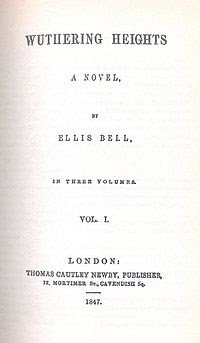
Wuthering Heights is a classic of the Victorian Era, written by Emily Bronte (and released in 1847). This was the only work of fiction by Emily, although her more famous sister, Charlotte Bronte wrote many more works of fiction (including the very famous Jane Eyre). Wuthering Heights was released not under the name of Emily, but under a pseudonym of Ellis Bell (because there was a prejudice in society that time directed at female writers, and Charlotte was also writing under a different name). Emily died the next year, in 1848, and a second edition was released later in 1850, edited by Charlotte. Emily had a relatively short life, and lived only from 1818 to 1848, dying after contracting tuberculosis.
Wuthering Heights was not a great hit when it came out, given that depiction of relationships and am over-riding sense of revenge and cruelty ran through the book. However, over the years, the book has come to become much more respected, and is now considered a literary classic, with many considering it superior to Jane Eyre.
The narrative is essentially about how emotions can guide the behavior of a person, with feelings of rejection and hatred making a person spend his entire life in revenge, tormenting people, seeking to get revenge. It is also a tale of unrequited love, with the passionate love between Heathcliff and Catherine Earnshaw (a love that had a tragic ending) causing Heathcliff to spend his entire life in how to get revenge. The narrative jumps a bit between the present and past, and is presented by 2 characters - Mr. Lockwood and Ellen "Nelly" Dean, with the main setting of the novel starting in the year 1801.
The novel starts with Heathcliff, a young homeless orphan is brought to Wuthering Heights by Mr. Earnshaw, and raised like another son. Heathcliff makes very close friends with the daughter, Catherine, although her brother, Hindley, does not like Heathcliff and mistreats him. After the death of Earnshaw, Hindley takes over as owner of Wuthering Heights, and badly treats Heathcliff. In the meanwhile, Catherine becomes close to a neighbor, Edgar Linton, something that Heathcliff does not like. He dislikes Linton.
Hindley's wife dies, and Hindley is in despair, taking on heavy drinking; around this time, Catherine decides to marry Linton, something that will profoundly affect Heathcliff. When Heathcliff leaves after feeling that Catherine considers it degrading to marry him, Catherine is struck by a fever, and Edgar Linton takes care of her, and in a couple of years, they get married. And then Heathcliff returns, having suddenly turned very wealthy, and intent on taking revenge on all those who prevented him from being with his love. He lends to Hindley, and then takes over Wuthering Heights after Hindley dies; further, he elopes with Linton's sister, Isabella, all for revenge. However, soon after, Catherine dies, with her and Heathcliff being reconciled just before her death.
Heathcliff becomes more angry, and hate prone, carrying on his hate onto the various children, Hindley's son Hareton, his own son Linton, and Catherine's and Edgar's daughter, also called Catherine. What will happen next, since eventually Isabella and Edgar Linton also die, leaving the various children at Heathcliff's mercy.


