Can't find what you are looking for ?
Google


Showing posts with label Victorian. Show all posts

Tuesday, September 29, 2009

English classic - Vanity Fair (1847-48)

A classic book by William Makepeace Thackeray, a satire about society in Victorian times, around the time of Napoleon, and contrasts the tale of 2 women, one of whom will do anything to get what she wants, and the other one, who is honest, believing, and trusts people even when they are not to be trusted.
A review of this book (link to article):

The title of the book, Vanity Fear, is taken from an earlier work, John Bunyan's allegorical story The Pilgrim's Progress, published long before in 1678, and supposed to represent a place called Vanity, where there is a ongoing fair that is meant to represent man's attachment to worldly things, and supposed to represent the sin of man. The book was seen as a bitter satire of society, as showcased in the quest of one of the anti-hero (or anti-heroine, to be more accurate), who is cunning, and uses all her qualities to work her way up in life.

Wednesday, September 9, 2009

Book: Emma by Jane Austen (1815)

Jane Austen wrote many books, with her most famous books being Sense and Sensibility (1811), Pride and Prejudice (1813), and Mansfield Park (1814). Emma came after these 3, and has taken its time to become famous. Further, since Jane Austen chose to write her books anonymously, her books started becoming famous long after her death, with a biography by her nephew, written more than 50 years after her death, that awoke more interest in her. It was only in the early half of the 20th century that she started being acknowledged as a classical writer, and now her works are very famous. Jane Austen remained unmarried, dying at the relatively young age of 42, from an affliction that was not particularly known at that time, but which is now suspected to be Addison's disease or Hodgkin's lymphoma.
Like her other works, Emma was also a critique of the society of that time, where a woman's standing was supposed to be based on marriage, and it would be this marriage that would decide her economic and social security; even though her works have a strong touch of comedy to them.


Emma is essentially a novel that describes the life of a 21 year old girl called 'Emma Woodhouse'. She is not worried about finances, being comfortably off; however, she starts to believe that she is good at match-making and guiding who should marry whom, something that causes a lot of temporary changes in the lives of people around her; in the end, however, everybody settles down happily, including her. There are a number of characters in the novel, and you will need to read carefully to ensure that you don't miss any of the turns and twists of the story.
Emma lives with her father, and has just returned from the marriage of her former governess Miss Taylor, and since she had introduced Miss Taylor to her husband, Emma feels that she has a gift for match-making. One of her closest friends is a person called George Knightley, who is from the neighboring estate, as well as the brother of her sister Isabelle's husband. He is perhaps the only one who is able to criticize actions taken by Emma when he feels that she is wrong. Who is the first person on whom Emma tries out this ability of hers ? It is her new friend, the 17 year old Harriet Smith, who is very sweet, but not very bright.
And here starts the main story. Harriet has got a proposal from a rich farmer called Mr. Martin, but Emma has decided that Mr. Martin is not good enough for Harriet, she would be more suited to the local vicar, Mr. Elton. And then, the unthinkable as per Emma happens - Mr. Elton realizes that Emma is a better catch, and proposes to Emma. Her friends had realized that this would happen, but not Emma. When Emma tries to direct Mr. Elton to Harriet, Mr. Elton makes it plain that he considers Harriet below him, and leaves the place for a while.
The story introduces more characters, and spins around the lives and marriages of these folks, and is fairly interesting.

Emma (1815), a book on England in the 19th century by Jane Austen

Saturday, August 29, 2009

Book: Wuthering Heights by Emily Bronte (1847)

Wuthering Heights is a classic of the Victorian Era, written by Emily Bronte (and released in 1847). This was the only work of fiction by Emily, although her more famous sister, Charlotte Bronte wrote many more works of fiction (including the very famous Jane Eyre). Wuthering Heights was released not under the name of Emily, but under a pseudonym of Ellis Bell (because there was a prejudice in society that time directed at female writers, and Charlotte was also writing under a different name). Emily died the next year, in 1848, and a second edition was released later in 1850, edited by Charlotte. Emily had a relatively short life, and lived only from 1818 to 1848, dying after contracting tuberculosis.
Wuthering Heights was not a great hit when it came out, given that depiction of relationships and am over-riding sense of revenge and cruelty ran through the book. However, over the years, the book has come to become much more respected, and is now considered a literary classic, with many considering it superior to Jane Eyre.
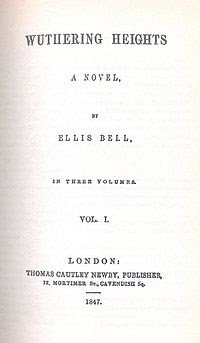
Wuthering Heights, a classic novel by Emily Bronte, published in 1847

The narrative is essentially about how emotions can guide the behavior of a person, with feelings of rejection and hatred making a person spend his entire life in revenge, tormenting people, seeking to get revenge. It is also a tale of unrequited love, with the passionate love between Heathcliff and Catherine Earnshaw (a love that had a tragic ending) causing Heathcliff to spend his entire life in how to get revenge. The narrative jumps a bit between the present and past, and is presented by 2 characters - Mr. Lockwood and Ellen "Nelly" Dean, with the main setting of the novel starting in the year 1801.
The novel starts with Heathcliff, a young homeless orphan is brought to Wuthering Heights by Mr. Earnshaw, and raised like another son. Heathcliff makes very close friends with the daughter, Catherine, although her brother, Hindley, does not like Heathcliff and mistreats him. After the death of Earnshaw, Hindley takes over as owner of Wuthering Heights, and badly treats Heathcliff. In the meanwhile, Catherine becomes close to a neighbor, Edgar Linton, something that Heathcliff does not like. He dislikes Linton.
Hindley's wife dies, and Hindley is in despair, taking on heavy drinking; around this time, Catherine decides to marry Linton, something that will profoundly affect Heathcliff. When Heathcliff leaves after feeling that Catherine considers it degrading to marry him, Catherine is struck by a fever, and Edgar Linton takes care of her, and in a couple of years, they get married. And then Heathcliff returns, having suddenly turned very wealthy, and intent on taking revenge on all those who prevented him from being with his love. He lends to Hindley, and then takes over Wuthering Heights after Hindley dies; further, he elopes with Linton's sister, Isabella, all for revenge. However, soon after, Catherine dies, with her and Heathcliff being reconciled just before her death.
Heathcliff becomes more angry, and hate prone, carrying on his hate onto the various children, Hindley's son Hareton, his own son Linton, and Catherine's and Edgar's daughter, also called Catherine. What will happen next, since eventually Isabella and Edgar Linton also die, leaving the various children at Heathcliff's mercy.